Capacity and labels
Old 70-Pint vs New 50-Pint Dehumidifier Labels: How to Compare Them
An old 70-pint label and a new 50-pint label are not equal numbers on one scale. The portable test got cooler, and reported capacity usually fell.
On this page
The labels are not on one scale
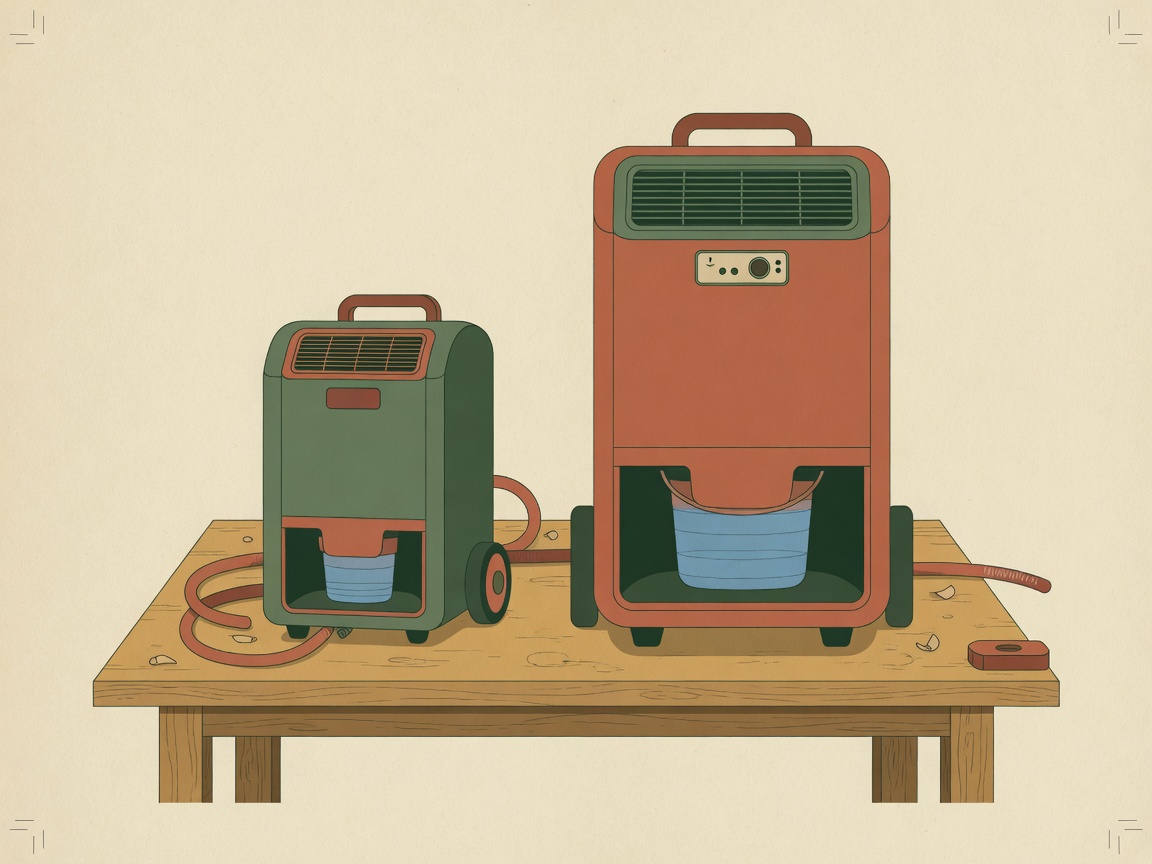
An old 70-pint portable label and a new 50-pint portable label are not a 20-pint performance gap. Capacity is water removed in 24 hours under specified test conditions. Portable dehumidifiers are now tested at 65°F rather than 80°F, and that cooler procedure generally produces a smaller reported capacity.
The test-method change is explained in DOE pint ratings. This page is the label translation: how to read an older box next to a current listing without declaring a winner.
Approximate conversions, not promises
Published correlations are a starting point, not a model-specific guarantee. For portable units, old ratings of 30, 40, 50, 60, 70, and 90 pints per day correspond roughly to new ratings of 20, 25, 30, 35, 40–45, and 55 pints per day. An old 70-pint label therefore sits around a new 40–45-pint rating, not automatically next to a new 50-pint rating.
For whole-home units, old ratings of 80, 100, 120, 140, 160, and 200 pints per day correspond roughly to new ratings of 70, 85, 100, 115, 135, and 170 pints per day. Actual changes vary by model, and some units also carry different energy ratings after the method change. Use the current documented rating on the specification sheet.
How to choose without mixing labels
Confirm both products are in the same category—portable or whole-home—before comparing pint numbers. Then put both on the current test basis, using the conversion only as a rough translation. Compare IEF on the current metric; DOE replaced EF with IEF for new ratings in June 2019, and the two are not interchangeable. ENERGY STAR bands for current IEF are in ENERGY STAR and IEF.
Finally, match the current capacity to the moisture load, temperature, and drain path. A new 50-pint class versus a new 35-pint class is a different question, covered in 35-pint versus 50-pint. The better fit is the model whose current specifications suit the space after the rating change is accounted for.
Sources
Keep reading
Related guides
35-Pint vs 50-Pint
A class-level decision from moisture load, not a product ranking.
Dehumidifier Capacity Classes
Read pint classes against moisture load, on the same rating basis.
DOE Pint Ratings Explained
What a pint rating measures, and when two numbers are not on the same scale.