Drainage
How Dehumidifiers Drain: Buckets, Hoses, and Built-In Pumps
Dehumidifiers send condensate to a bucket, a downhill hose, or a pump. Choose the method the model actually supports and the room can keep working.
On this page
Three ways water leaves the unit
Every dehumidifier has to drain the water it condenses. Portable units typically use an internal bucket, a gravity-fed hose, a built-in pump, or some combination. The right drain method is the one the model documents and the room can support—not the method that sounds most convenient on a product page.
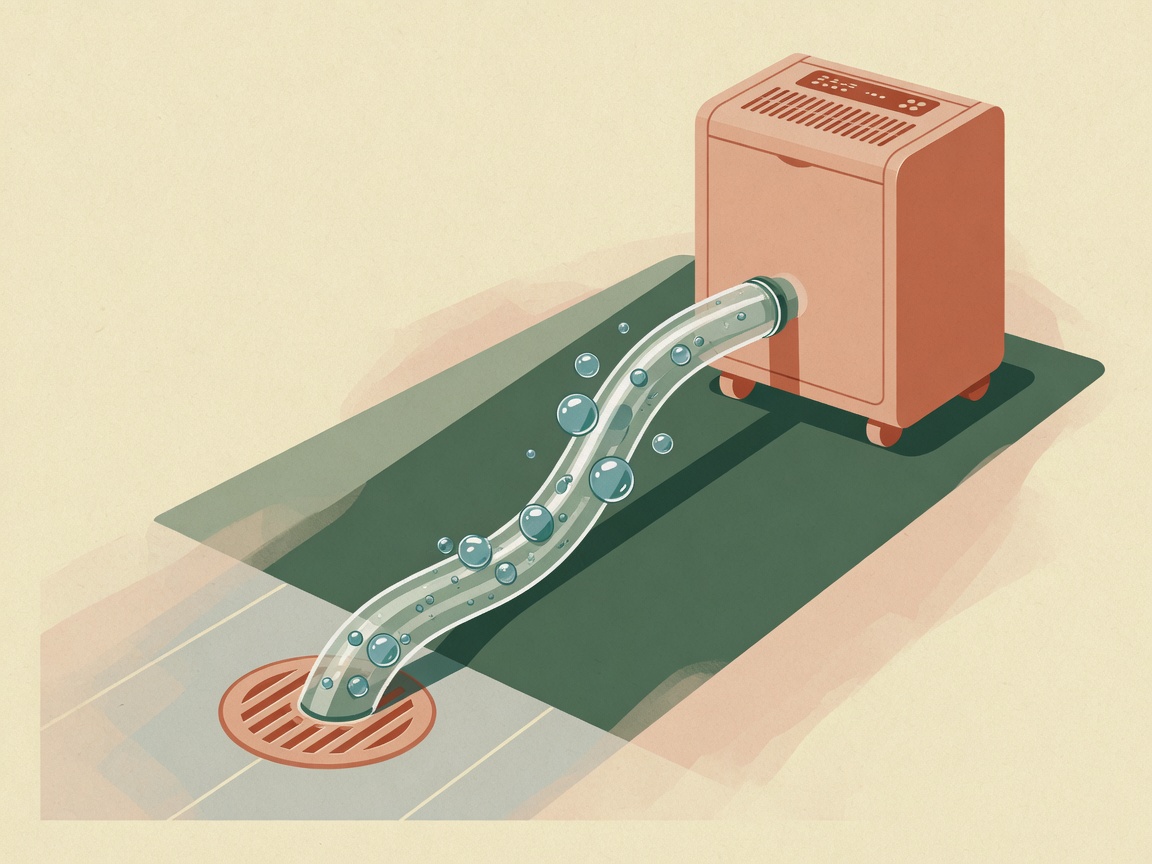
A bucket is the default on many portable units. It requires regular emptying and a shutoff when full. A gravity hose can reduce emptying when a floor drain or sink sits below the outlet and the hose can run continuously downhill. A pump can lift water to a higher drain, but only if that model includes a pump or an approved pump accessory. Choosing hose versus pump is covered in pump versus gravity drain.
Which drain method fits
Use this table to match the drain method to the room. The comparison of uphill versus downhill routes is in pump versus gravity drain.
| Method | Works when | Watch for |
|---|---|---|
| Bucket | You can empty it on a reliable schedule | Full-bucket shutoff and a stable, level cabinet |
| Gravity hose | The drain sits below the outlet and the hose can slope downhill | Kinks, uphill runs, and loose connections |
| Built-in pump | The documented pump can reach the discharge point | Lift limits, pump outlet, and model-specific hardware |
What the drain label does not decide
A drain port is not proof the unit will run unattended in your layout. Hose diameter, adapters, and pump lift are model-specific. A family manual that says a pump exists on some models is not evidence that a particular SKU has one.
Choosing between a downhill hose and a pump, once you know the site, is the job of pump versus gravity drain. Connecting a hose without leaks is the job of continuous drain setup. Keep this page to identifying the three methods and what each one requires of the room.
Before you rely on continuous drainage
Confirm the outlet on the actual model, the hose or pump hardware it specifies, and any control setting that enables continuous drain. Place the unit so a leak or overflow cannot damage the surrounding area. After setup, watch one collection cycle: the connection stays dry, water reaches the destination, and the unit does not shut off on a false full-bucket signal. The hookup steps are in how to set up a continuous drain.
If you still empty a bucket by hand, rinse and dry it as part of ordinary upkeep. A drain method does not replace filter care or a working humidistat.
Sources
Keep reading
Related guides
Continuous Drain Setup
Connect the specified hose, slope the run, and test for leaks.
How to Choose a Dehumidifier
Match capacity, drain path, and upkeep to the job — not a square-footage claim.
How to Maintain a Dehumidifier
Bucket, filter, and drain-path checks that keep the unit collecting.